

Frequently asked questions about equipment repair
A repair corrects the failure that stopped the machine and restores what sits immediately around it. The seal that was weeping is replaced, the bearing that was running hot, the torn diaphragm, and whatever sat next to them is checked for collateral damage. The machine goes back with the fault gone and the rest of its wear exactly where it was. An overhaul does not start from a fault. The machine comes apart completely, every journal, bore and running clearance is measured against the original drawing, and anything outside tolerance is replaced whether or not it caused a breakdown. What goes back together is a machine returned to its build dimensions rather than to the condition it was in yesterday.
The practical marker is the history, not how dramatic the failure looked. A machine that ran clean for four years and then lost one seal needs a repair. A machine that has eaten three seals in eighteen months does not have a seal problem: it has a shaft that has taken a bend, bearing journals gone oval, or an alignment that walks away as soon as the pipework warms up. Fitting a new part into that destroys it again within weeks. The second marker is output. Where pressure or flow has slipped away slowly and nothing has actually broken, the wear is spread across every clearance at once, and only a full strip-down finds it.
We settle that question on the strip-down bench rather than on the phone, because the answer lives in the measurements. The machine is opened, measured and photographed, and we come back with what is outside tolerance and what is not, before anything is committed. If a repair will hold, we do the repair and we say so. If it will not, we say that too. DRN Industriel assembles, repairs and overhauls this equipment out of its Mirabel shop, and holds the wear parts for the most requested models on the shelf.
Sometimes, which is why the question comes up every week. A mechanical seal has a finite life, and one that ran for several years before it began to weep has simply reached the end of it. But the seal is also the most sensitive component on the machine, and it is where everything happening elsewhere gets written down. A bent shaft, a worn journal, an alignment that has walked, a pump running in cavitation, or one running far from its best efficiency point all present the same way from outside: a damp patch under the stuffing box. Replacing the seal without checking shaft runout is changing the bulb on a circuit that is overheating.
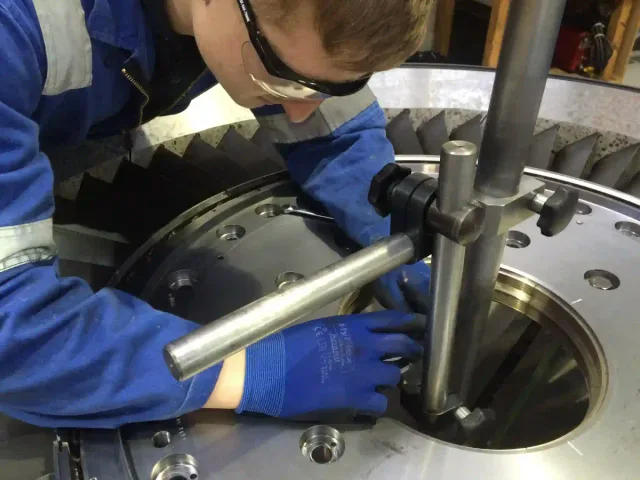
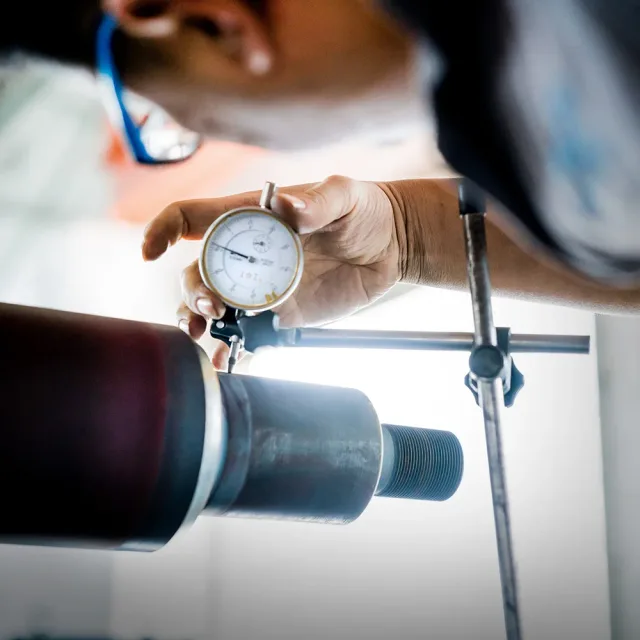
Three checks separate the two cases, and they take an hour. Shaft runout at the seal face is read with a dial indicator: past about five hundredths of a millimetre, no seal will last whatever it cost. Bearing end float and radial clearance are taken at the same time. Then the faces themselves give the cause away: evenly polished faces mean a normal end of life, star-shaped scoring means particles got between them, heat-checked or cracked faces mean the pump ran dry, and an elastomer that has swollen or gone hard means either a chemical the material does not suit or a running temperature higher than the one on the data sheet.
That inspection is the one we run before any new seal goes in, because a pump that comes back twice for the same leak costs more than the hour of measurement that would have prevented it. We keep seals, impellers and bearings for the models our customers replace most often on the shelf, so a common part does not wait on a shipment. If the measurement shows a shaft outside tolerance we show you that before going further, and the decision to repair, overhaul or replace stays yours.
Three things, and the third is the one that gets left out. First the nameplate: make, model, serial number, impeller size and speed. A sharp photograph of the plate beats a transcribed reference, because one digit read wrong sends the parts search into the wrong family altogether. Then the real operating conditions: the liquid and its temperature, the flow and head being asked for, the solids content, and the duty cycle. Last, the history of the machine, meaning what changed shortly before the problem showed up. A modified process, a valve throttled further, a sump level dropped, a temperature raised: that is almost always where the cause is sitting.
One example makes that third point concrete. A pump that ran six years without incident and then breaks two shafts in three months did not age overnight. In almost every case something around it moved: a fouled exchanger raised the back pressure, a suction strainer partly blocked, or production asked for a lower flow and the discharge valve was closed down to get it. The machine then works far to the left of its curve, radial thrust deflects the shaft on every revolution, and the break is a consequence rather than a cause. Repairing it without correcting the operating regime guarantees the next one.
With those three things our specialists identify the machine, find the parts that actually fit it, and tell you what is on the shelf before the machine leaves your site. Our technicians size, assemble and repair this equipment out of Mirabel, and that includes older models whose manufacturer no longer publishes parts. If all you have is the nameplate, start with that and we will come back to you for the rest.
More than most plants expect. A line withdrawn from the catalogue is still a machine whose dimensions, materials and running clearances are known, and most of what wears on it was never unique to that line in the first place. Bearings are standard catalogue references. Mechanical seals cross to an equivalent as soon as shaft diameter, housing length and chemical compatibility are matched. O-rings are found by size and material. What is genuinely particular to the machine, and therefore genuinely hard, usually comes down to the impeller, the shaft and the wear rings, and those three are measurable and can be made again.
The clearance that decides the outcome is the one between impeller and wear ring, because it governs volumetric efficiency. On a centrifugal pump that gap opens as it wears, part of the discharge flow recirculates back to the eye, and the machine draws the same power while delivering less. An honest rebuild resets that clearance to the original figure, which means knowing the figure rather than estimating it. The second point is material: an impeller remade in a softer grade than the original will survive its first start and wear out twice as fast on anything carrying solids.
This is the case where the inventory matters most. DRN Industriel keeps a broad stock of pumps and parts, including rare and older components the manufacturers no longer hold, and our technicians assemble and repair these machines in Mirabel using parts for the models customers struggle to find anywhere else. Send us the nameplate and, if you have it, a photograph of the worn part. We will tell you what still exists, what crosses to an equivalent, and what has to be remade to measured dimensions.
Three conditions decide it, and the age of the machine is not one of them. The first is the state of the casing and the frame. While the volute, the joint face and the bearing housings are sound, everything else is replaceable and a rebuild is the short road. A casing eaten through by erosion or a cracked frame closes the conversation. The second is whether the machine still suits the duty it is actually doing: if the process has changed since it was installed, rebuilding a badly sized machine commits the wrong choice for another ten years. The third is the availability of the parts particular to it, which means the impeller, the shaft and the wear rings.
A straight comparison almost always leaves out what surrounds the machine. A new unit from another line rarely changes only the badge: the flanges move, the shaft height changes, the foundation has to be reworked, the coupling and sometimes the motor follow, and the pipework has to be realigned. On a station installed twenty years ago that rework regularly costs more than the machine. A rebuild, by contrast, goes back into the same bolt holes without touching the civil work, and keeps the spares already sitting in the storeroom usable. That is why the question is settled on the whole installation and not on the equipment alone.
A decision taken off a catalogue page shows itself at start-up. A decision taken on measured dimensions, on the real condition of the casing and on the duty the machine has to do today shows itself in service and holds. We open the machine, we measure it, and we put both roads in front of you with what each one commits you to. DRN Industriel has sized, selected and troubleshot process equipment for more than 35 years, which means we have watched both go wrong.
Tell us the machine and the symptom
Send the nameplate and what you are seeing. We come back with what to check, what we hold on the shelf, and the work the machine actually needs.