
Abrasive slurry pumping for the mining industry

Ore-laden slurry does not pump like clean water. A pump selected off a clear-water curve loses head, drifts away from its best efficiency point and wears through parts far faster than the design expected. What the plant sees is unplanned stoppages and emergency replacements.
DRN Industriel has worked on the sizing, selection and troubleshooting of process equipment for more than 35 years, across Quebec and Eastern Canada. On a slurry circuit that means correcting the curve for your ore, settling the right wear material and overhauling what is already installed.
Wear comes from solid particles striking the impeller, the casing and the liners again and again. It concentrates where relative velocity is highest: the impeller leading edge and the front wear face.
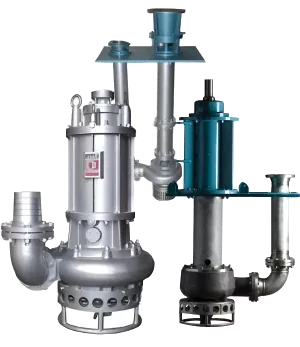
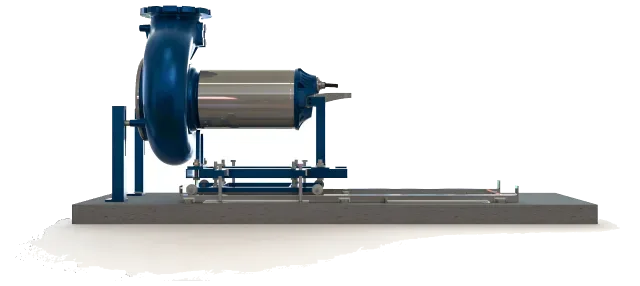
A large impeller, low speed, wide passages and sacrificial parts built to be swapped: geometry decides service life, not installed power.
The three process families on a mine site do not call for the same pump. Processing needs a machine that takes a dense slurry continuously; transfer needs one that self-primes on intermittent volumes.
Lift duty, for its part, has to pass whole solids without clogging. Three regimes, three geometries and one selection principle: start from the duty, never from the catalogue.
We start from your actual duty point, correct the manufacturer curve for your slurry, then settle on an impeller large enough to hold the head at reduced speed.
On a machine already installed, the workshop measures clearances and surface condition before proposing anything: a properly done overhaul often returns the original performance.
A pump sized for its slurry wears at a predictable rate. Service intervals become something you can plan, stoppages stop being emergencies, and lifecycle cost falls without a single part changing supplier.
Our technical specialists answer within the hour during business hours, most common parts ship the same day, and delivery runs 24 to 48 hours across North America.
The questions below are the ones our specialists field most often on a mining slurry circuit. The answers cover the method of selection and upkeep; model and series detail lives on the equipment pages.
Sizing starts with four measurements: the density of the solids, the concentration by weight, the particle size distribution and the density of the resulting slurry. Those values are what correct the manufacturer curve, which is established on clean water. Available head drops, efficiency falls and absorbed power rises. Skipping that correction is the most common error on an ore circuit, because the pump looks right on paper.
Next comes the settling velocity, the speed below which particles stop being carried by the fluid and drop to the bottom of the line. A circuit sized too close to it blocks; one sized too fast wears the pipe and the pump for nothing. The usable window is narrow and depends on particle size as much as on flow, which is why two neighbouring mines do not settle on the same pump.
With the corrected curve in hand the rest follows in order: an impeller large enough to hold the head at a reduced peripheral speed, then the wear material, the shaft sealing and the drive. We work from your own readings rather than a catalogue average, because an average slurry exists on no site.
That leaves the suction side, which the habit of clean water tends to make people forget. A slurry that degasses or entrains air loses available suction head far faster than clean water at the same flow, and the pump begins to cavitate with nothing having changed on the discharge. A suction line sized too wide also lets solids settle before they ever reach the impeller. We check both before closing a selection.
Elastomers absorb the energy of fine, rounded particles striking the wall at a low angle, and they stand up to most corrosive slurries. On finely ground ore a rubber impeller and liners often outlast an equivalent metal, at lower mass. Their limit is mechanical: a coarse or angular particle does not bounce, it cuts.
High-chrome hard metal takes those particles and the higher head per stage that would tear an elastomer. In exchange it wears faster under fine abrasion and tolerates thermal shock poorly. That is why one site sometimes settles on rubber downstream of grinding and hard metal upstream of it.
In practice two variables separate the families: the size of the largest particles the pump will see, and the head asked of each stage. Add the chemistry of the carrier fluid, which can rule out an otherwise sound metal. We ask those three questions before proposing a material, and we read the wear on the machine in place where there is one.
One useful point: the impeller and the liners do not have to be the same material. It is common to keep a hard metal impeller, which sees the heaviest impacts, with rubber liners that handle the finer abrasion of the rest of the circuit better. Better still, those parts change without touching the pump body or the pipework, so a first material choice is never final.
Because wear does not track speed, it outruns it. Doubling the peripheral speed of an impeller does not double the wear: it raises it considerably more. That is why a slurry pump is built around a large impeller turning slowly, where a clear-water pump would move the same flow with a small fast one.
Hence the most frequent trap: choosing a pump too large, then throttling it on a valve to get back to the flow you wanted. The machine then works far from its best efficiency point, internal recirculation sets in, and the wear parts go much faster than the calculation allowed for.
The symptom is recognizable without instruments: parts changed far more often than planned with no failure to explain it, and a discharge valve left permanently half shut. The fix runs through impeller diameter and drive speed, not through the valve.
Two corrections exist, and neither runs through the valve. Trimming the impeller diameter brings the head down without touching speed; changing the drive ratio or fitting a variable speed drive brings the speed down without touching the impeller. The second leaves adjustment room that the first removes for good. That is why we favour a pump that can hold the point in the lower part of its speed range.
On a centrifugal slurry pump the genuinely useful stock list is short: the impeller, the throatbush, the front and back casing liners, the shaft sleeve, the expeller ring and the gland packing. Those parts are sacrificial by design; replacing them is normal upkeep, not a repair.
They do not all wear at the same rate. The impeller and the throatbush go first, because that is where the relative velocity of the particles is highest. Holding those two on site, with the gland packing, covers most stoppages; the rest can be ordered as needed.
DRN keeps a large inventory of pumps and parts, including rare and older components the manufacturers no longer hold. We can draw up the wear-part list specific to your machine from its serial number, which avoids ordering a near-match that will not fit.
That leaves knowing when to change them. The calendar is a poor guide, because wear follows the ore and not the months. The useful measurement is the clearance between impeller and throatbush: it opens progressively, and head and efficiency both degrade well before anything fails. Logging that clearance at each planned shutdown gives a wear curve specific to the installation, and that curve is what sets the right interval.
A worn casing does not condemn the pump. Resetting clearances, renewing the impeller and liners, redoing the sealing and aligning the drive often bring a machine back to its original performance, for a fraction of replacement and without touching the existing pipework.
We handle general repair, maintenance contracts and complete overhauls of pumps, fans, mixers and packaged systems. The workshop measures clearances and surface condition before proposing anything, so the decision rests on the real state of the machine.
Replacement earns its place in one case: when the duty itself has changed. More abrasive ore, a higher flow or a revised head push the pump outside the range it was selected for, and no overhaul corrects a selection that has become wrong. Even then, the lead time on a specialized slurry pump is rarely short, and an interim overhaul often buys the production the new machine cannot deliver yet.
Between those two cases there is a third route few people ask for: using the overhaul to correct the original selection. The machine is open, the impeller is already out, and that is the cheapest moment to change a diameter, move from an elastomer to a hard metal or rework the sealing. A pump poorly chosen at the outset then comes back matched to its real slurry, with no machine purchased.
Few operations can reproduce their own slurry on a rig, and most laboratory trials cost more than the pump. So we work from three sources: your process readings, the curves the manufacturer publishes, and the wear observed on the machine already in place. On a greenfield duty that third source does not exist: we start instead from a comparable installation and select with speed headroom, so the first correction costs an impeller trim rather than a pump.
That last source is the most underused. The shape of the wear says where the energy is going: a bitten leading edge, a throatbush hollowed on one side only, or a casing scored at the outlet each tell a different story, and each leads to a different correction.
When the doubt sits on a single parameter, a trial on the running machine settles it faster than a study: changing an impeller diameter or a drive speed shows up within a few weeks of production. Our specialists can help you read the existing wear before you commit to anything.
A validation is only worth something if it is comparable. Record the flow, the discharge pressure, the absorbed power and the throat clearance at commissioning, then at the same points at every shutdown. Three readings are enough to show a trend, and a trend beats a laboratory trial on a reconstituted slurry that will never be quite yours.
In ore processing the slurry is dense, loaded and continuous. The lined, slow-turning centrifugal slurry pump is the rule there because it is the only one that takes that regime for hours on end without losing its internal geometry.
In transfer the volumes are intermittent and the fluids often aggressive: reagents, decant streams, sump bottoms. The air-operated diaphragm pump wins there because it self-primes, tolerates running dry and works without electricity, which matters in a poorly served area.
In lift duty the problem is no longer abrasion but clogging: whole solids and stringy material have to pass. A recessed or vortex impeller gives up efficiency to manage it, and that is a deliberate trade. The three regimes often live on one site, and it is the duty that names the family.
The three regimes converge on one point, and it is the one that brings costs down: inventory. A site that settles on two slurry pump sizes in processing rather than five, and a single diaphragm pump series in transfer, cuts the number of wear-part references it has to hold without giving anything up on the process side. We look for that convergence when sizing a station, because an isolated selection always costs more to maintain.
Send us your duty point, your ore and the wear history of the machine in place. You get back a selection corrected for your slurry, the matching wear-part list and, where an overhaul is enough, a workshop assessment instead of a new machine.
To get a fast answer, include the nameplate of the pump in place, or its serial number, and a photograph of the worn part if you have one. That is what saves us coming back to you for missing information.